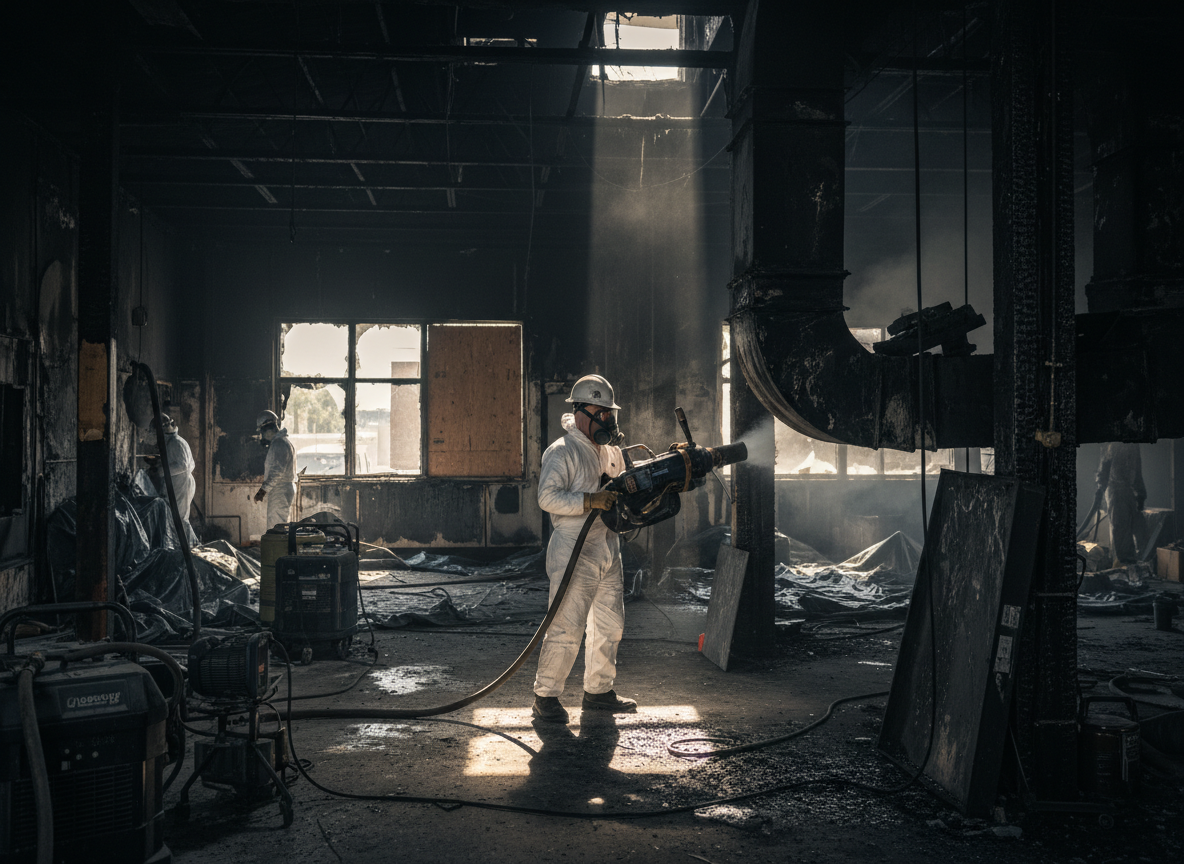
Commercial properties in Midway City and nearby Westminster often feature 1960s to 1980s construction with drop ceilings, HVAC systems, and shared wall voids that allow smoke to travel beyond the fire origin. In Orange County's mild Mediterranean climate, low humidity lets fine soot particles settle deeply into porous materials like acoustic tiles and insulation before restoration crews arrive. This requires thorough negative-air pressure setups and HEPA filtration to prevent cross-contamination into adjacent tenant spaces along Beach Blvd corridors.
Restoration crews must account for California commercial building codes on electrical and mechanical systems when removing charred components. Garden Grove-adjacent sites frequently show hidden corrosion in metal framing after water suppression, which can weaken load-bearing elements if not addressed during cleaning. Technicians test for pH levels in residue and use specialized agents that won't damage concrete floors common in local strip centers while restoring surfaces to pre-loss condition.
Edge cases include odor reappearance weeks later when seasonal temperature shifts draw trapped particulates from wall cavities. Proper documentation of every step protects owners from insurance disputes common in multi-tenant Orange County buildings where responsibility boundaries blur between units.
Technician insight
In Midway City, the thing that catches most people out with Commercial fire restoration is how the mild Mediterranean climate lets soot travel through shared wall voids in 1970s strip-center construction along Beach Blvd, turning a single-unit incident into multi-tenant work if crews skip early negative-pressure containment.
Retail Unit Smoke Intrusion
A fire started in a small commercial kitchen on Beach Blvd and pushed smoke into neighboring retail spaces through the shared HVAC. Inspection revealed heavy soot in ceiling voids typical of older Midway City buildings. Crews isolated the system, extracted residue from multiple units, and restored surfaces without disrupting adjacent operations. The property returned to full use after targeted cleaning.
How it works
- 1
Initial Assessment
Technicians inspect the full commercial footprint, map smoke paths through HVAC and voids, and document affected materials in Midway City structures.
- 2
Containment and Safety
Set up barriers and negative pressure to isolate work zones, protecting neighboring businesses along Beach Blvd from further exposure.
- 3
Residue Removal
Apply targeted cleaning agents and extraction methods suited to local commercial surfaces while monitoring air quality throughout the process.
- 4
Structural Restoration
Repair or replace damaged elements, verify system integrity, and return the space to operational standards.
- 5
Final Verification
Conduct clearance testing and walkthrough with the owner to confirm all areas meet pre-loss conditions.
Pricing
Commercial fire restoration pricing depends on building size, extent of smoke migration, and material types; site visits yield upfront quotes.