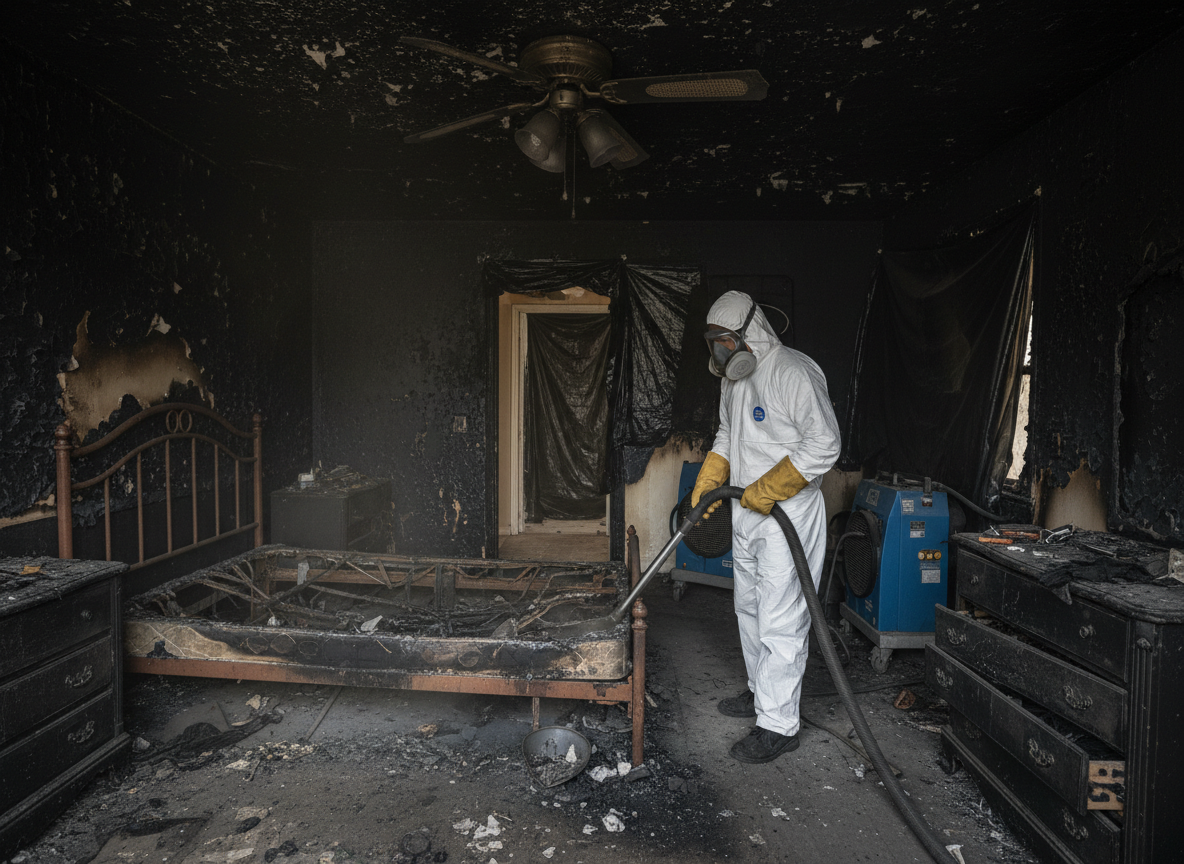
Bedroom fires in Midway City often involve older single-family homes built before 1970 with plaster walls and hardwood floors common throughout Orange County neighborhoods. Soot travels through HVAC registers and settles into carpet padding and mattress fibers, requiring HEPA vacuuming followed by chemical neutralization rather than simple wiping. Electrical wiring in these homes frequently runs through knob-and-tube or early Romex, so technicians must isolate circuits before any wet cleaning begins to avoid hidden shorts.
Mild Mediterranean climate keeps relative humidity moderate most of the year, which slows corrosion on metal bed frames and light fixtures but allows acidic smoke residues to bond tightly to drywall paper and wood trim. Crews test pH levels on surfaces before applying alkaline cleaners; failure to neutralize can cause recurring odor weeks later when windows are opened during spring weather shifts. Contents like clothing and bedding are inventoried, bagged, and sent for off-site ozone or thermal deodorization when on-site treatment risks cross-contamination.
Local building codes in unincorporated Midway City require permits for any structural drywall replacement exceeding 100 square feet. Technicians document pre-existing water stains from seasonal roof leaks common near Garden Grove borders so insurance adjusters can separate fire-related damage from prior issues. Final clearance includes particle counts under 0.3 microns to confirm airborne soot has been removed before reoccupancy.
Seasonal Considerations
Dry fall winds increase ember intrusion through window screens in Midway City bedrooms; sealing these openings during initial board-up prevents secondary ember damage that homeowners often overlook until after the main cleanup.
Common Materials Encountered
Plaster-over-lath walls, oak flooring, and wool carpets typical in pre-1960 homes demand different cleaning chemistry than modern drywall and synthetic carpet found in newer Westminster subdivisions.
Technician insight
In Midway City, the thing that catches most people out with Bedroom fire damage cleanup is how the older plaster walls and single-pane windows let smoke travel into the attic space above the bedroom, especially when the mild Mediterranean climate keeps homes closed up for weeks at a time. Homeowners often miss the soot that has settled on rafters until the next Santa Ana wind event pulls it back down.
Electrical Fire in Westminster-Adjacent Home
A bedroom fire started from an overloaded outlet in a 1960s Midway City house. We found soot had migrated through ceiling joists into the shared attic with the neighboring property. After isolating power and setting containment, we removed affected plaster sections, cleaned all surfaces, and treated the attic space before reinstalling new drywall and passing clearance tests.
How it works
- 1
Initial Assessment
Technicians inspect soot depth, test surfaces for pH, and map smoke migration paths through HVAC and wall cavities in the Midway City bedroom.
- 2
Containment and Safety
Plastic barriers isolate the room, circuits are locked out, and negative air machines capture airborne particles before any removal work starts.
- 3
Soot and Residue Removal
HEPA vacuums, dry sponging, and pH-adjusted cleaners lift residues from plaster, wood, and fabric without spreading contamination to adjacent rooms.
- 4
Deodorization and Clearance
Ozone or hydroxyl units treat remaining odors, followed by post-clean particle testing and documentation for insurance in Orange County.
Pricing
Upfront written estimates based on square footage, material types, and smoke travel extent; no hidden fees after scope is agreed.